
What Is a DAO? (Plain English)
A DAO (Decentralized Autonomous Organization) is a group of people who coordinate and make decisions using blockchain-based rules instead of centralized leadership. Think of a DAO as An organization whose rules are transparent, enforced by code, and shaped by its members. No CEO, No hidden board, No backroom decisions
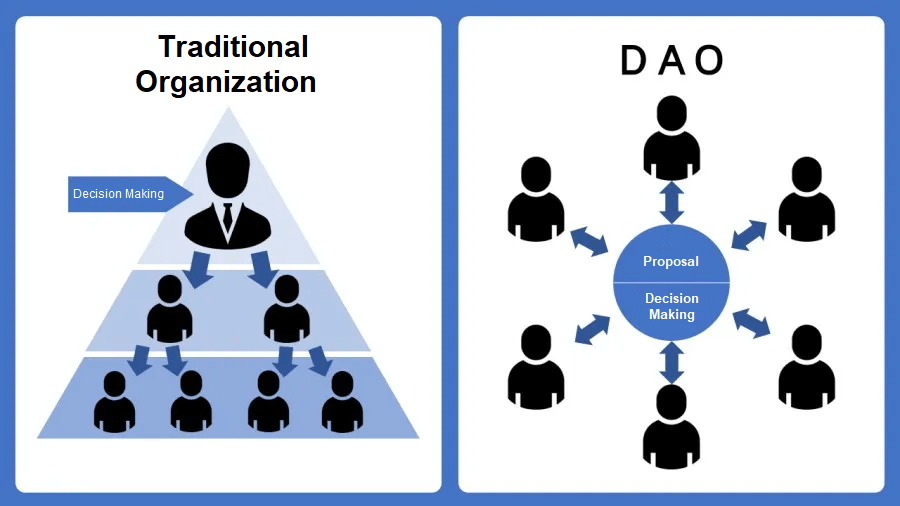
The Core Shift
Traditional organizations:People trust leaders to follow rules.
DAOs:
- Rules are enforced automatically and visible to everyone.
What Makes a DAO a DAO?
A DAO typically includes:
- A shared mission
- Smart contracts that define rules
- Tokens or NFTs that represent participation
- Transparent voting mechanisms
- On-chain records of decisions
How DAO Voting Works (Simple)
NFTs can function as:
- A proposal is created
- Members review it
- Votes are cast using tokens or NFTs
- Results are recorded transparently
- Outcomes are executed or honored
No altered outcomes.
One Token = One Vote? Not Always
DAO voting can be:
- One-token-one-vote
- Reputation-based
- NFT-based
- Quadratic voting
- Delegated voting
DAO Tools in Practice
One widely used governance tool is Snapshot
Snapshot allows DAOs to:
✔ Propose ideas
✔ Vote without transaction fees
✔ Record outcomes transparently
It’s commonly used for community governance, creator collectives, and protocol decisions.
What DAOs Are Used For
DAOs can govern:
- Creative collectives
- Open-source software
- Investment groups
- Education communities
- Protocol upgrades
- Content curation
- Shared treasuries
DAOs for Creators & Communities
For creators, DAOs enable:
✔ Shared ownership
✔ Revenue transparency
✔ Community voting on direction
✔ Fair contribution recognition
✔ Collective IP stewardship
Instead of followers, you get stakeholders.
DAOs in Education & Knowledge
DAOs can:
- Vote on curriculum changes
- Fund new learning content
- Reward contributors
- Govern open education platforms
- Maintain shared credentials
What DAOs Are Not
❌ Not chaos
❌ Not leaderless by default
❌ Not automatic success
❌ Not immune to bad design
DAOs are powerful — but only when structured intentionally.
How DAOs Connect to the Web3 Stack
DAOs rely on:
➡ Wallets (identity)
➡ Blockchains (recordkeeping)
➡ Smart contracts (rules)
➡ NFTs / tokens (membership & voting)
They are the coordination layer of Web3.